45th Annual Conference and Business Meeting on Tire Science and Technology
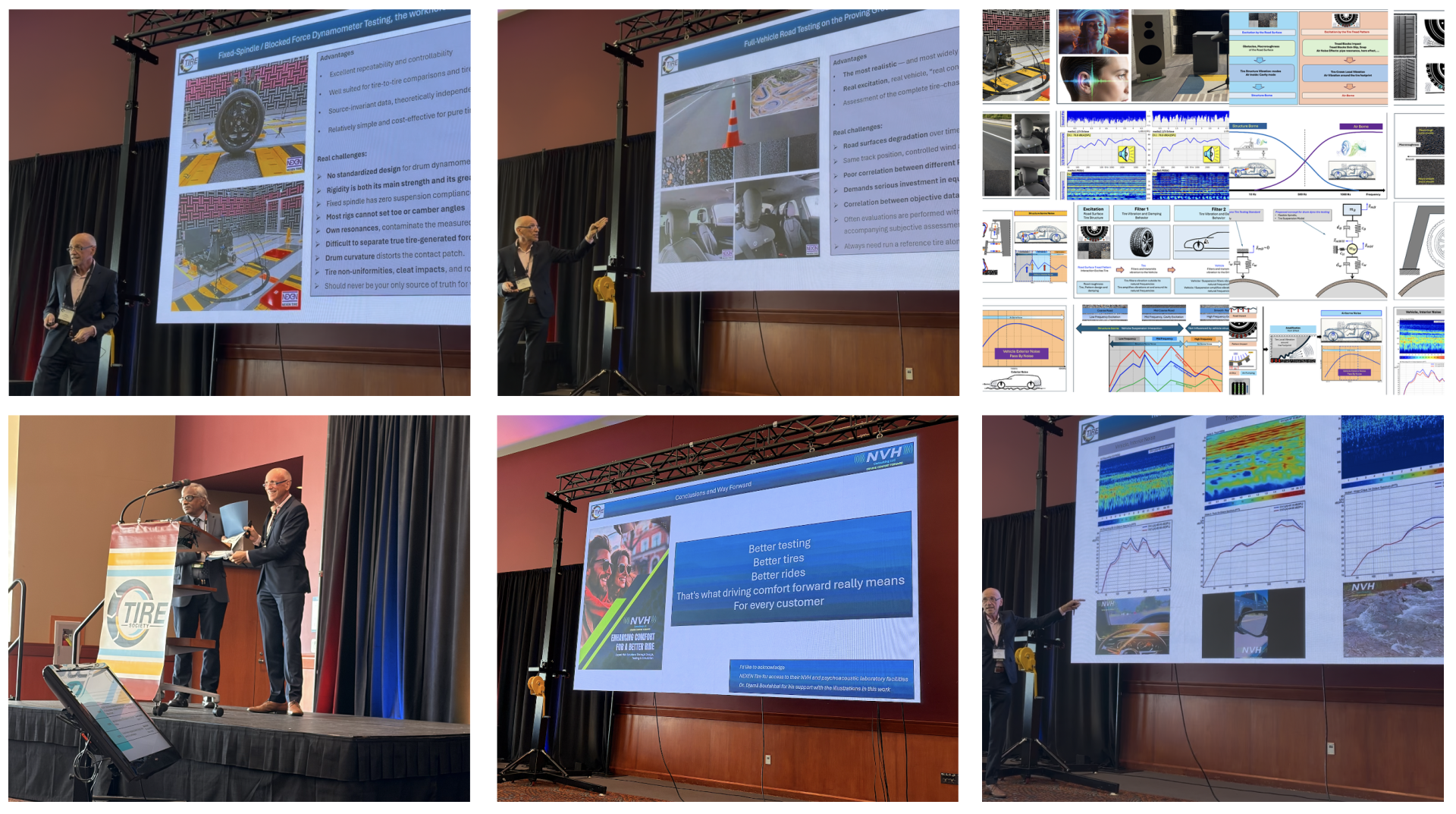
In September, I had the honor of presenting as a featured speaker at the 45th Annual Conference and Business Meeting on Tire Science and Technology of The Tire Society in Akron, Ohio.
Pankau will present:
My topic: “Tyre NVH and Ride Comfort: Critical Review of Testing Methods through the Lens of Tyre-Road Interaction – Strategies, Surfaces, Pros, Cons, and Pathways Forward.”
The main points:
The main points:
🔹 Different test methods give different answers. OEMs and tire manufacturers often evaluate the same tire with different methods and get inconsistent results. The first step toward harmonizing them is to understand what each one actually measures.
🔹 Tire-road interaction sets the excitation. Road texture, speed, and tread design determine which mechanisms dominate: structural modes and cavity resonance at low frequencies, tread pattern and air pumping at higher ones. The same tire can rank differently on different surfaces, so surface selection is part of the test method.
🔹 The noise path is a chain of filters. Tire, vehicle, and human perception each shape what the customer finally hears. Objective spectra alone miss the last filter, so psychoacoustic and subjective evaluation belong in the process.
🔹 Full-vehicle testing is the reference, but not the only tool. It gives real excitation and real vehicle response, but proving-ground conditions change and correlation between sites is often weak. Fixed-spindle dyno testing is valuable for early development and tire-to-tire comparison, but it has no suspension compliance, so above roughly 150–200 Hz the measured forces increasingly reflect the rig.
🔹 Boundary conditions matter on the test bench. A rigid fixed-spindle dyno has no suspension compliance, so above roughly 150–200 Hz the measured forces increasingly reflect the rig rather than the tire. It remains valuable for early development and tire-to-tire comparison, but should not be the only basis for vehicle-level noise prediction.
🔹 No single method is enough. Simulation needs validation against physical measurement, and psychoacoustic evaluation belongs in the standard toolkit. The most reliable path is an intelligent combination of methods, not one “ideal” test.
🔹 A path forward. A flexible spindle rig, a compliant suspension corner with a rolling tire, combined with full-field scanning laser vibrometry, could show how suspension compliance changes tire vibration transfer.
Thank you to the Tire Society organizers and to the audience for the engaged questions. The technical discussions afterwards with colleagues from Michelin, Goodyear, and Nexen Tire were especially valuable. It was also a pleasure to meet Dr. Thomas J.R. Hughes and learn about the history of the finite element method from his presentation.
If you work on tire-vehicle correlation, test method harmonization, or experimental validation for simulation, I’d like to hear from you.