Tire Noise Under Acceleration
Why “Accelerated Drive (Pass-By)” Conditions Demand Special Attention in Tread Pattern Design
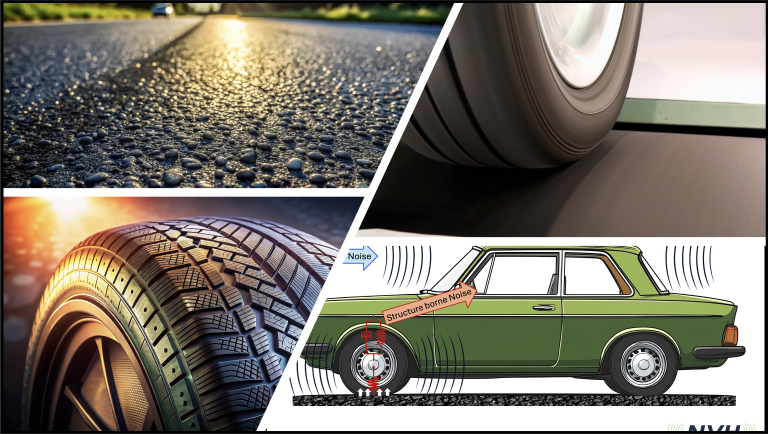
In tire development, pass-by noise testing tells only part of the story. The real challenge emerges under acceleration — the “Accelerated Drive” scenario — where torque transmission dramatically changes tire behavior and amplifies noise generation.
Here are some critical insights from tire-pavement interaction dynamics:
– Torque-induced forces reshape the footprint — Applied drive torque alters contact patch shape and pressure distribution, leading to uneven deformation. This intensifies tread block impact on the road, boosts shear stresses at the edges, and significantly increases overall pattern-induced noise compared to constant-speed rolling.
– Motion-state-specific designs are key — Effective noise mitigation requires tread patterns tailored to the driving state.
– Driven axles show stronger effects — Driven tires (front in FWD, rear in RWD) experience pronounced torque effects, often generating higher noise levels than free-rolling ones. Axle-specific pattern optimization — or even directional/asymmetric designs — becomes essential for balanced performance across the vehicle.
– Optimized edge geometry reduces shear noise
– Hybrid stiffness zones in the tread (softer in center for comfort, stiffer at shoulders to manage torque-induced deformation).
– Advanced materials like low-hysteresis compounds in select tread areas to dampen torque-excited vibrations without sacrificing wear.
Reducing accelerated tire noise isn’t just about meeting regulations — it’s about delivering a premium driving experience, especially as powertrains get quieter (EVs!) and road/tire interaction becomes the dominant source.
What approaches have you seen or implemented to tackle torque-induced tire noise? I’d love to hear your experiences or favorite design tricks in the comments!
#TireTechnology #AutomotiveEngineering #NoiseReduction #TireDesign #EVNoise #PassByNoise #TreadPattern